Navigating through the world of Common Core, 21st century relevancy, and middle school hormones!
Tuesday, July 30, 2013
Minds on Mathematics: Chapter 10 (Sharing and Recognition)
So… I've finally caught up with my chapter posts since vacation! Phew…. that was a lot of reading and reflecting, but I've done it. I really loved this book and know that I'll refer to it over and over again.
Speaking of reflection, that's what this chapter was about. The author discusses the importance of granting our students time each day to think about what they have learned.
Metacognition - thinking about our thinking - is the last step in a daily math workshop. It gives the student time to sit back and process the items that they've covered during the class period. They can think about things they understand, topics that are still unclear, and "a-ha" moment, or state something in a different way to help cement material. It allows students to take a short, quiet moment to put the period at the end of the class and finalize their thoughts (instead of that mad rush of shoving papers in backpacks, tossing books on the shelf, and running out the door because the bell rang).
For my own classes, I will be utilizing my math journal (Math Survival Guides, MSG) for this purpose. I will actually be doing this twice during my 111-minute class period. I am going to have students reflect just prior to the mini lesson in the middle of class and again at the end. Below is an example of a page I've created for one of our first units:
Notice on the right side the three topics - Write, Reflect, Review. I am going to have my students complete one set of pages (for example, this is 5/6) each class period. The left will hold drawings, foldables, and creative items. The right side will almost always be Write, Reflect, Review (now that I'm typing, maybe I should switch the last two…?). Write will contain any important information outside of the notes I'd like students to have. Reflect will be something they think about and can write on prior to our lesson - possibly bringing in some background knowledge or items from the notes they are working on. Review will be my "end of the day" piece, similar to the exit ticket. I liked all of the suggestions listed in the book and mine will vary between questions for clarification, to explaining their understanding, to writing about what they'd like me to go over. Since it will be in their journals, I'll probably collect them on quiz/test days to grade and may also glance at them while walking around during work time.
I do like the idea of reflection, but I have to come up with a system that works for me. I tried exit slips, but being able to read, grade, and possibly give good feedback became overwhelming. I'm excited to try the MSG system and see if it works. I'm hoping this helps get the students in the habit of reflecting at the end of each class period.
Mind On Mathematics: Chapter 9 (Conferring)
Conferring is not something I've done systematically within my classroom at all. I know I've seen it done within my own children's elementary classes, but middle school is a whole new ball game! I think I've done it informally when I circulate between my groups - looking for understanding, stopping to explain things, etc. But… I haven't ever kept a record of the conversations or looked for particular items that were preplanned.
My biggest take-away from this chapter was on the classroom management of conferring. I never thought to explain about it to the students, it was just something I did. However, by setting clear expectations and following the "never interrupt" rule, I think it will help with noise level and activity when you are not looking around.
The two things I see that I will have to work on are the record keeping system and time management. I guess I will have to decide what exactly I'd want to keep track of within the records. Hmmmm…. that's going to take some thought. I'd love some feedback and ideas from anyone who has done this before. I also will need to set a goal of how many students I will confer with each class period. If I leave it random, I know that I have the potential to just let it go.
Good chapter - tons to think over on this one!
Minds on Mathematics: Chapter 8 (Work Time)
Hoffer describes four aspects of Work Time during a math workshop:
- Planning around vigorous tasks that drive understanding;
- Planning students' working groups to ensure that all are thinking;
- Training students to engage as independent mathematicians during work time;
- Stepping back from helping and instead serving as facilitator and data collector.
I've seen this work within my own field testing with very positive outcomes. I gave two incentives for my class: a lunch pizza for the highest scoring group and getting to keep their group (if they wanted) if the entire group scored 70% or higher on the test. This really seemed to motivate everyone and scores soared!
One thing I will need to work on is #1 - vigorous tasks. I have two new math teachers at my grade level and I think they are going to be a big help with this. We will basically be rewriting how we teach each unit, based on the aspects above. I've really been utilizing Illustrative Mathematics, Inside Mathematics, and the Mathematics Assessment Project (MARS) site. They have great interactive investigations to really challenge the students.
I also liked the strategies Hoffer suggests for grouping students. I loved the Appointment Clock way of grouping and think I might use that with our journals. I agree with the thought that students can definitely tell when they are grouped by ability level. My daughter hates that… She came home this year and asked me, "Why do the teachers always put a smart kid with the kids who don't do anything?". I had to feel a little guilty when she asked because I know I've done this before. I appreciated talking to her about her perspective.
This chapter is full of such practical ideas for a math workshop and I can see them really working well within my block class. I will definitely bookmark it and come back to check it out again before school begins!
Minds on Mathematics: Chapter 7 (Mini Lessons)
Chapter 7 in Minds on Mathematics discusses the mini lesson. I think this is great, especially since I teach such a long block each day. I started using mini lessons last spring and think that they work out great. Instead of the sleepy, bored, or uninterested stares I get when teaching up on the board, the students have tons of time to work on their activities and only have to engage as a full group for short time periods.
"A mini lesson is a quick and strategically designed to support students in developing acuity as independent mathematicians: a short, focused segment of whole-group instruction led by the teacher for ten or fewer minutes." (p. 103)
What I loved about this chapter were all of the practical suggestions - things I need to ensure I'm doing. I loved the explanation on modeling your thinking. I always assume I'm doing that, but not necessarily to the level explained. Hoffers examples of how to show thinking strategies will be good to reference later: Real-Life Examples, Anchor Charts, Context, Thinking Aloud, and Hold Thinking will become resources in my teaching toolbox.
One thing I didn't necessarily think was great for the middle level were the quick checks for understanding. I often use a version of the Fist of Five when my students are all facing forward, but I don't think I'd use the Stand-ups or Line-ups to check on how they are doing - too much of a lack of privacy for the students. One thing I will have them do is draw a happy face, frown face, or face with a squiggly line on their paper and I'll walk around to see their understanding that way. Everyone likes to draw faces (I see some great artwork this way) and they don't have to worry about what others think.
Sunday, July 28, 2013
Minds on Mathematics - Chapter 6 (Opening)
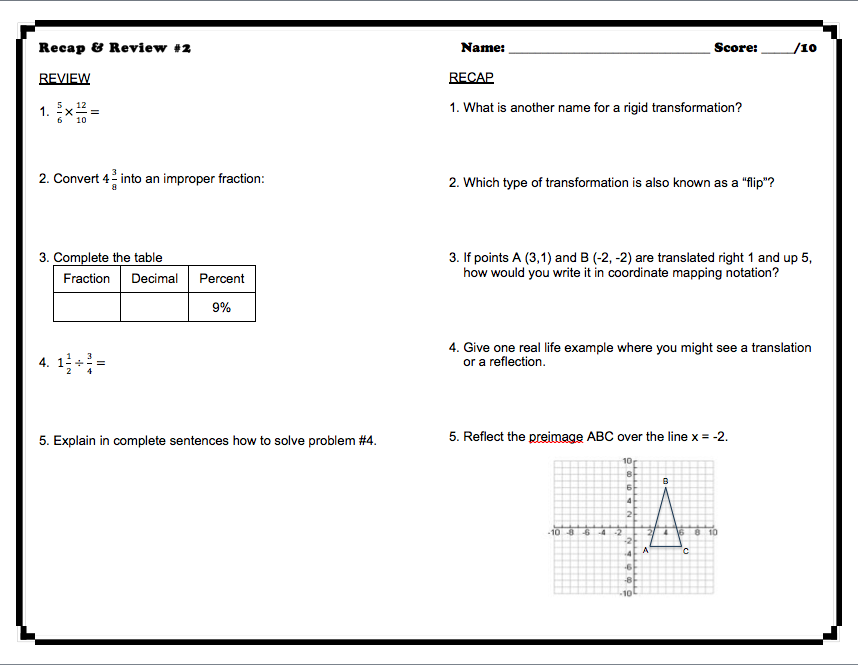
Now we're getting into the meat of things…! I thought this was a great chapter. I know that most of us probably start with some sort of warm-up activity. I know I do. What got me in this chapter was on how to structure the warm-up. We've used Math Minutes previously and this year I've decided to write my own. I wanted to have half of my questions be strictly review of material learned throughout the year, and half of my questions be a recap of what was learned during the previous class. It looks something like this:
So, I was really into this (and have created my first 10)… until now. After reading this chapter, I may have to rethink this a bit. Or at least rethink the next 10 :). I don't really have any open ended questions (except maybe #5) and I liked the reference to using those during warm-up time in chapter. Since I have 111 minutes during my class period, I have some flexibility with the length of the warm-ups and have found that 10 questions is a good length. Possibly I could keep the 5 Review questions and then have the Recap question be something more open ended (maybe not called Recap?). Hmmmmmm……………..
I liked the Accountability Structure Hoffer suggests on page 96. It is important to have a way to ensure that students are participating in the warm-up activity, especially if it's not going to be graded. I liked the "Give One - Get One" strategy - I haven't heard of that before.
I also liked the short synopsis of homework at the beginning of class. I too grade very little homework and find that it helps keep up with paperwork. However, this means there have to be plenty of other graded assignments, simply for parents to see how their kids are doing. I tend to go for the Weekly Quiz, using the homework as a basis for it. This takes a little shuffling since we are on the block schedule, and turns into more of a quiz every other week, so that I've seen the students around 5 times.
Good, working chapter. Excited to keep going!
Saturday, July 27, 2013
Minds on Mathematics - Chapter 5 (Discourse)
This is a key chapter in the text, because without constructive and meaningful discourse among students, a math workshop will not be successful. My favorite quote in this chapter is, "When students are engaged as learners, sharing, discussing, and evaluating one another's thinking in a mutually supportive (emphasis mine) setting, they are constructing their own understanding of the concepts at hand". I love this… It's difficult to do, but if you can, the math that will be happening in the classroom will be wonderful!
Hoffer contends that discourse:
- Engages learners - students want to talk to each other. Working together gets them excited.
- Promotes understanding - it helps students explain their reasoning and talk over ideas.
- Develop communication and collaboration skills - they need to know how to work together.
- Supports academic language development - students need to know, understand, and use the vocabulary.
In order to promote discourse there needs to be an atmosphere of respect in the classroom. Students need to feel welcome to share ideas or questions. I really liked the prompts that are listed on pg. 76 - 77 and I plan to post them in my room.
This chapter holds a wealth of information on discourse, all of which I really enjoyed. I'll have to read it again and figure out what I missed the first time, but all the ideas are easily implemented and worthwhile.
Minds on Mathematics: Chapter 4 (Community)
I enjoyed this chapter because it reinforces what I found last spring when I field tested a learner-centered classroom - student like working together! When I had the students fill out their post-survey on this type of classroom, the two most frequent comments they wrote were, "I like being able to work at my own pace" and "I like that we could work with others". I found that I had more "math" going on in my classroom using this method than in the traditional teaching style.
I agree with the book, though, you have to set your expectations and let students know when they are not performing the way you desire. They should be talking math, not about their weekends (although, that will happen, it just shouldn't be the focus for the majority of the time). I like the discussion on page 52-53 about "norms" and having the students help develop what will essentially be the classroom rules.
I like that the author really broke down how to run a collaborative classroom. It's not easy and you have to be willing to give up some control. Your classroom will not be quiet, either, but students will be engaged. This was very difficult for my type-A personality, but I ended this class each day so pleased with my students' work, so it was worth it.
She talks about accountability - not having one student hold the group together - by using individual preparation, entry and exit tickets, peer observations, and warm calling. I added on to this by having each group member give their other group members a grade that I would also take into consideration. I gave a each individual a separate "group" grade at the end of the unit based on my observations and the secret grade of their peers. Students could give a 3 (my group member worked hard for a majority of the unit and participated with the group), 2 (my group member mostly worked with us, but didn't always participate with the group), 1 (my group member worked with us sometimes and didn't really participate), or 0 (my group member didn't work with us at all). I think this really helped those students who don't like group work because they feel like they always carry the group, feel better because they had a little control.
Great chapter!
Subscribe to:
Posts (Atom)